Do you know of a House or Senate action that was conducted without Sunshine? Help build the record. Send your leak to:
Superferry hearings held in virtual lockdown condition
When this website was created there were certain reforms that looked urgent. Life goes on, of course, even at the Legislature. At this writing legislative leadership has locked down the facility, oops, I mean the State Capitol. They are excluding the public from the decisionmaking process around creating an exemption to Hawaii's protective environmental laws for one company--the Hawaii Superferry.
Working with the Lingle administration's secret draft bill, they are poised to steamroll a new law through a special session. Current news reports are that hearings originally planned for the Neighbor Islands will not be held after all.
For more information on this and related Superferry articles, see Disappeared News.
It's clear that additional reforms are needed. Besides reforms requiring the Legislature to be at least partially subject to the Sunshine Law, we should consider that committee chairs should not be allowed to kill any bills that have substantial testimony or other indication of public support. This was an issue in the current Superferry fiasco but has affected much more, especially controversial issues such as domestic partnerships and death with dignity bills. Letting one person override the will of hundreds of testifiers is a denial of democracy in Hawaii.
Will legislators reform themselves? Not bloody likely. Getting the corporate lobbiests out of legislators' offices last session was a long, hard slog. They seem to be enjoying themselves this week as they get press attention for standing up for the Superferry. It will no doubt take a constitutional convention to bring about meaningful reform.
I don't know if I would support holding a constitutional convention because of all the damage that could be done, but if it turns out that one is to be held (voters decide), then we should be prepared to fight for Sunshine and meaningful legislative reform.
Senate President Bunda introduced a resolution to ban corporate interns
I learned today from KITV reporter Denby Fawcett that SR168 was introduced by Sen. Bunda to change Senate rules so that embedded corporate lobbyists would no longer be allowed. Unfortunately, the resolution wasn't adopted.
Let's keep the pressure on, and perhaps the rule can be changed in the next session.
Now about the House...
House Minority Leader calls attention to breach of 24-hour notice for 30 bills
 House Minority Leader Rep. Lynn Finnegan decried the lack of notification on a flock of bills passed out of the House this week.
"The majority rushed through some 30 bills yesterday, instead of giving members of the House and the public 24 hour advanced notice before voting on final reading."
In her Tuesday news release, Rep. Finnegan acknowledges that the 24 hour notice is practiced as a courtesy. Courtesy or not, the incident demonstrates that House procedures can and are altered at whim.
Star-Bulletin article on complaints
See today's Star-Bulletin article: Executive's role as intern at Legislature questioned and this Disappeared News post.
And yes, please sign the petition if you have not yet done so. Thank you!
Reform effort moving along: Read Ethics Commission Documents, PBN articles
Click here to read a letter from the Hawaii State Ethics Commission to legislators dated April 5, 2006.
Click here to read the most recent complaint, by Kokua Council.
Click here for the Pacific Business News article Companies place workers at State Capitol dated 3/21/2006.
Click here for the Pacific Business News article Capitol interns to get ethics review dated 4/7/2006.
David Shapiro on how legislators killed reform bill
In today's Honolulu Advertiser Volcanic Ash column, Legislators work hard for their money, David Shapiro describes how the gutting and replacement of SB1061, a bill passed unanimously by the Senate, was used to keep lobbyist money flowing in:
Giving credit where due, the Senate did unanimously pass a worthwhile reform this year to prohibit lobbyists from making political donations when the Legislature is in session.
But the measure was quickly derailed in the House by the most devious of means.
Rep. Sylvia Luke, Judiciary Committee chairwoman, gutted the Senate bill on lobbyist donations and inserted unrelated language that could have rolled back the state's "sunshine law."
Alarmed sunshine advocates demanded that Luke table the reconstituted bill, which she gladly did — bloodlessly killing the underlying campaign-reform measure in the process.
Activists who support both open government and clean elections were left frozen in their tracks.
Luke said the lobbyist restrictions could still come back this session in another vehicle, but don't wait to exhale on that one.
She used the same dodge last year when she killed a bill tightening Hawai'i's shamefully lax bribery laws for public officials.
It's a shame that lawmakers reserve their best creativity for protecting their own interests and those of their benefactors.
Imagine the good things that could happen if they applied such ingenuity to solving Hawai'i's problems.
Worse, she did it
without a public hearing, although the record falsely indicates she held one.
Another secret bill: SB1015
I received an email tip to check out this bill. Here's what I found: We're being cheated again as the House Water, Land, & Ocean Resources Committee hides its actions from the public.
The text of SB1015 is posted on the Capitol website here. On Friday afternoon the committee sent out a hearing notice for Tuesday. The notice says "PROPOSED HD1 available in room 432." The new text is described:
Gives BLNR up to 12/31/07, the authorization to reinstate a 999-year homestead lease that was canceled due to nonpayment of arrearages; provided, among other things, that the tenant-at-will has continually occupied the land and has cured all arrearages.
Ok, I have no idea what this is about. It's clearly designed for some special situation.
I'm not likely to find out, of course, until Tuesday morning, and only if I choose to run over to the Capitol just before the hearing.
Today is Kuhio Day, a state holiday. For three days since the notice was issued, the text of this proposed amendment has been unavailable. I couldn't prepare testimony even if I wanted to.
More troubling is that Tuesday is its first and last public hearing, and you can bet the chair's recommendation to his committee will be to pass it. The public will not have participated at all in the making of this new law.If you live on Neighbor Islands, forget it. That's the idea, actually--this House committee chair, Rep. Ezra R. Kanoho, joins his fellow chairpersons of darkness in employing this technique that
locks the public out of the democratic process.The repetition of this abuse demonstrates that committee chairs and House leadership are quite happy to trample on the public's right to participate in the making of its laws. It should have been stopped when it was first used, and it shouldn't be allowed now.
This abuse should be prohibited--
please sign the petition.
Bill text unavailable to the public: SB3186
Hawaii's gas cap law has been the subject of controversy, with the Senate tending to revise the current law and the House preferring to repeal it. The public should have been given every opportunity to review the proposed measures and to give their testimony to lawmakers.
Instead, text of the proposed House amendments were effectively withheld from the majority of the public, and a hearing was schedule to coincide with the Senate hearing (same date, same time) on the gas cap so that the public could not attend both at once.
The hearing notice refers to a proposed amendment available only in "Room 314":
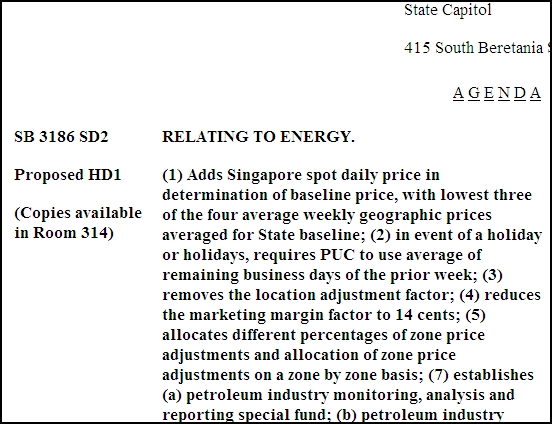
This amendment is 61 pages long.
Because of the length of the amendment, sufficient time should be allowed for the public to read it. In fact, few members of the public could obtain a copy at all because of the necessity to drive to the Capitol, park, and pick one up. At the same time, it is very likely that members of the oil industry and other special interests had copies.
This action violates sunshine because the text of the measure heard by committee members was not available to the majority of the public but would presumably have been seen by oil industry representatives. This action violates process because the House should not have scheduled its hearing at the same time the Senate was hearing the same matter.
Disappeared bill SB1061
Example: House Judiciary Committee
The bill SB1061 on the Capitol website "Prohibits a lobbyist who lobbies the legislature, principal of a lobbyist, client or agent of lobbyist, and a political action committee on which the lobbyist sits from making a contribution to a member of the legislature, the governor, and lieutenant governor while the legislature is in session."
According to the status page, it was heard on Tuesday, 03-21-06 at 2:00 pm in House conference room 325 and the committee recommended that the measure be deferred. This never happened. This bill, which had popular support and was passed unanimously by the Senate, was never heard.
Instead, the hearing notice, sent out at the last minute on Friday, referred to the following text:
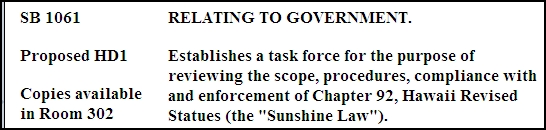
Since "Room 302" was closed over the weekend, the public had no access to this "proposed HD1", which is, in fact, not an amendment to the original bill at all. No copy would be available until Monday morning, the day before the hearing. Note that House rules require 48 hours notice before a hearing. The text was not available in that time frame. The public was also required to drive in to the Capitol in order to obtain a copy. Not only do many people live far away or on a Neighbor Island, most cannot take off from work.
This action violates trust in the integrity of government because the record falsely indicates that SB1061 was heard, but it was never heard. This action violates sunshine because the text of the measure heard by committee members was not available to the majority of the public. This action violates process because the proposed text was not introduced at the beginning of the session and it was not heard or voted on previously, nor does it relate to the original bill in any way.
Senate committee hides secret amendments, wastes testifiers' time
The question of whether psychologists should have prescriptive authority under HB2589 has been very contentious with lobbyists busy lobbying and a great deal of written and oral testimony submitted.
A hearing on this bill was held on March 20, 2006 by the Senate Health Committee and was very lengthy, with some testifiers preparing and submitting detailed material.
After hearing all the testimony, the Chair revealed that she had prepared a detailed amendment, which she described briefly, and recommended that the committee pass the measure with the as yet unrevealed (to the public) amendment.
This action violates sunshine because the text of the amendment prepared by the Chair in advance and voted on by committee members was not available to the public at any time. This action violates trust because the Chair essentially wasted the time of numerous testifiers who had taken the time to prepare material and sit through the long session, including persons who stated that they had taken vacation time from work in order to do so. The public was testifying on a measure that had already been superseded because the Chair intended to offer the unrevealed amendment to the committee for a vote. The public testimony on either side was rendered irrelevant because the amendment had been prepared in advance.